In short
- Bring your ID card, recent test results and a list of your medicines.
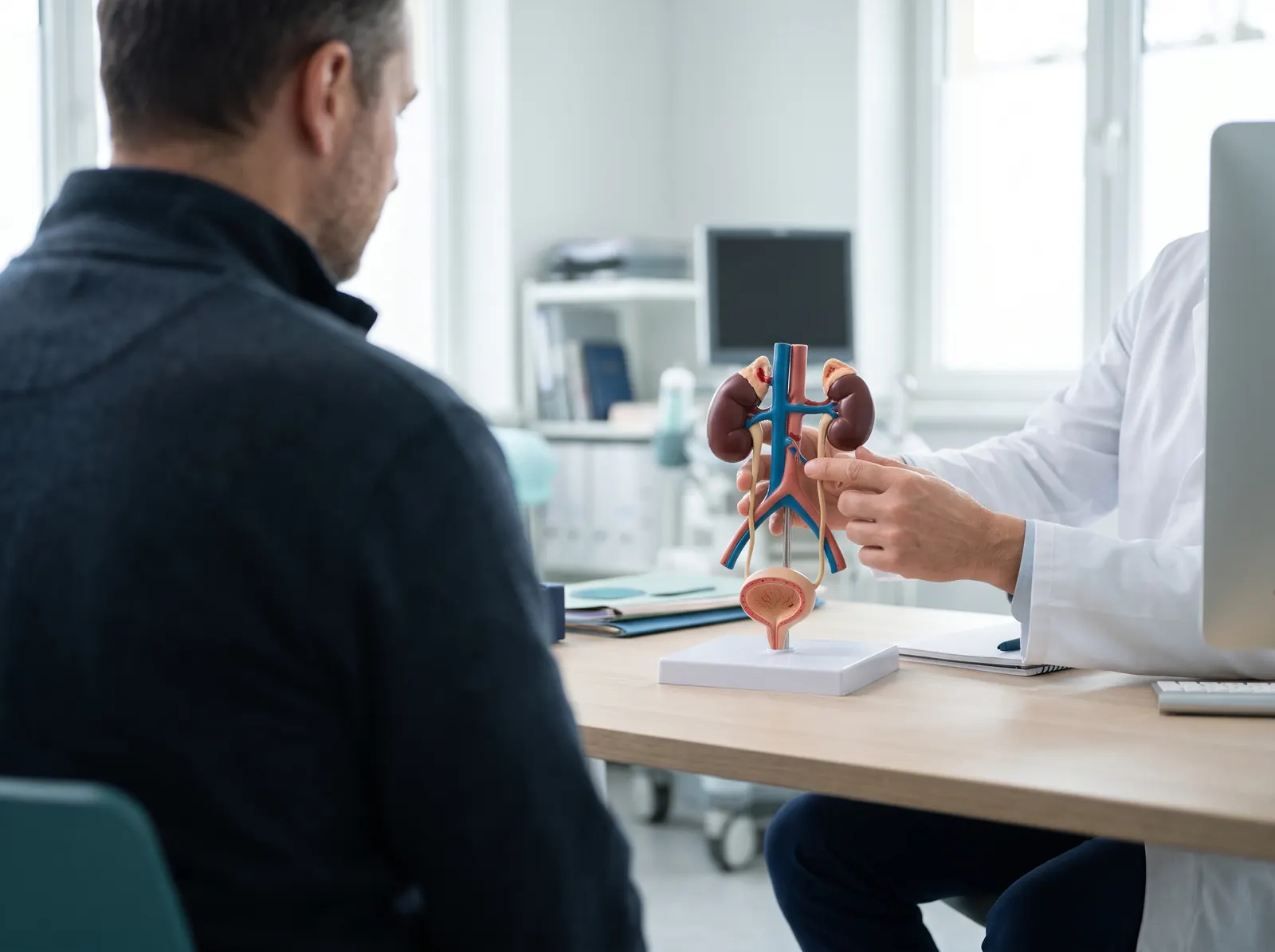
- The doctor asks questions, examines you and explains what he thinks.
- A urine test, an ultrasound or a flow test can be done on the spot.
- You can book online, without a referral letter.
In this article
What should I bring?
To get the most out of your appointment, remember to bring:
- Your ID card
- Recent blood tests, urine tests and scans
- A list of your medicines, especially blood thinners
- A letter from your GP, if you have one (it is not required)
How does the consultation work?
The doctor starts by listening: when the symptoms began, what makes them worse, your medical history and your medicines. He then examines you, with your consent.
For the prostate, the examination often includes a rectal examination: it is quick, a little uncomfortable but not painful, and gives valuable information.
Tests on the same day
Depending on the reason for your visit, some tests can be done during the consultation: urine test, ultrasound of the kidneys, bladder or prostate, or a flow test to measure your urine stream. For a flow test, arrive needing to pass urine; for a bladder ultrasound, come with a full bladder.
Talking about intimate subjects
Erection problems, leaks, fertility: these topics are part of a urologist’s daily work. Everything you say is covered by medical confidentiality. Write your questions down beforehand so you do not forget anything.
How do I book?
The easiest way is to book online on Rosa, choosing the location and time. You can also call Sainte-Anne Saint-Rémi hospital on 02 434 30 31 or the Basilique clinic on 02 434 21 11. Consultations are in French or English.
Questions to prepare
The doctor will often ask these questions: thinking about them beforehand saves time.
- How long have you had these symptoms?
- How many times do you pass urine by day and at night?
- Is there a family history (prostate, stones, cancer)?
- Which treatments have you already tried?
After the consultation
You leave with an explanation, advice, a prescription or tests to arrange. Results are discussed at a follow-up appointment, and your GP is kept informed. For urinary symptoms, a bladder diary over two or three days (times and volumes) is very useful.
Frequently asked questions
How long does the consultation last?
As long as it takes to understand your problem and answer your questions. If tests are done on the spot, allow a little extra time.
Can someone come with me?
Yes, you are welcome to bring someone with you.
How can I find out about fees?
For any question about fees and reimbursement, ask the hospital when you book.
Learn more
- CareBook an appointment
- CarePreparing your visit
- CareUrological ultrasoundUltrasound uses sound waves to look at the kidneys, bladder, prostate and testicles.
- CareUroflowmetryUroflowmetry measures the strength and volume of your urine flow.
More advice
 Enlarged prostate: symptoms and treatment of benign prostatic enlargementWeak stream, getting up at night, bladder not emptying: how to recognise benign prostate enlargement and the treatments available, from tablets to surgery.Read the article
 Urinary leakage: what are the solutions for women and men?Leaks on exertion, sudden urges, leaks after prostate surgery: the types of incontinence and the solutions, from pelvic floor exercises to surgery.Read the article
 Sudden urges to urinate: understanding overactive bladderSudden, frequent urges, getting up at night, sometimes leaks: the causes of overactive bladder and the treatments that make daily life easier.Read the article
This information is general and does not replace a consultation. In an emergency, call 112.
Article published by Dr Ayhan Bakar, urologist in Brussels (INAMI 17718534450).
Reference: European Association of Urology (EAU) guidelines.