In short
- Low-intensity shockwave therapy aims to improve blood flow in the penis.
- It is best suited to mild to moderate erectile dysfunction with a vascular cause.
- PRP uses plasma from your own blood; its effectiveness is still being studied.
- Both are done in the office, without a hospital stay, after a consultation.
In this article
How shockwave therapy works
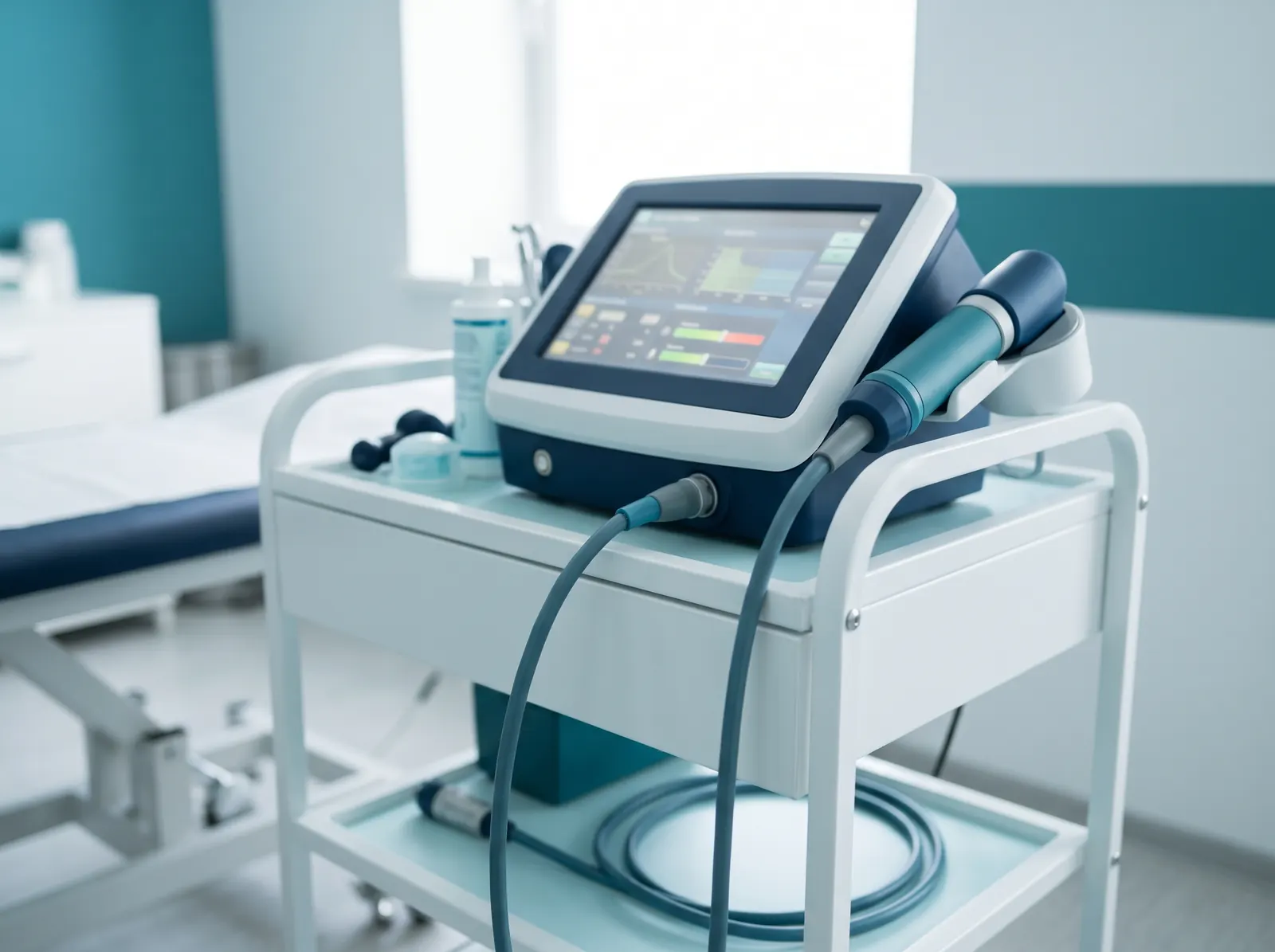
An applicator placed on the penis delivers low-intensity sound waves. They stimulate natural repair processes and the growth of small blood vessels, which improves blood flow.
The aim is to act on the vascular cause of the problem, not just to produce a one-off erection.
What does a course involve?
Treatment consists of several short sessions spread over a few weeks. They take place in the office, without anaesthetic, and are painless for most patients. You can get on with your day straight afterwards. The number of sessions and the cost are explained at the consultation.
Who is it for?
Shockwave therapy is mainly used in these situations:
- Mild to moderate erectile dysfunction with a vascular cause
- Men who respond poorly to tablets or want to rely on them less
- Alongside other treatments
And PRP?
PRP (platelet-rich plasma) is prepared from a blood sample: after the blood is spun, the platelet-rich part is injected into the penis. Platelets contain growth factors that may help tissue repair.
The available studies are still limited: PRP is offered as an add-on, after an honest discussion of what it can achieve.
What results can I expect?
Improvement is gradual and usually appears in the weeks after the course. Results vary from one man to another and are better when lifestyle is also addressed: smoking, exercise, weight, diabetes.
Precautions
Treatment is not offered with a major clotting disorder, a local infection or certain diseases of the penis. The prior consultation checks that nothing rules it out.
Shockwave, PRP or both?
Shockwave therapy has the most experience behind it for vascular erectile dysfunction. PRP is sometimes added as a complement. The choice depends on the cause, its severity and your expectations: it is made together, after the assessment.
Frequently asked questions
Does shockwave therapy hurt?
No, most patients feel at most a slight tingling. No anaesthetic is needed.
How much do the sessions cost?
The number of sessions and the cost depend on your situation; they are explained at the consultation.
Should I stop my tablets during the course?
Not necessarily. Your andrologist will tell you whether to continue them during and after treatment.
Learn more
- CareLow-intensity shockwave therapyLow-intensity shockwave therapy (LI-ESWT) is a non-invasive medical technology.
- CarePenile PRPPRP (platelet-rich plasma) is prepared from your own blood.
- CareErectile dysfunctionErectile dysfunction is the ongoing inability to get or keep an erection firm enough for satisfying sex.
More advice
 Recurrent urinary tract infections: causes and solutionsCystitis that keeps coming back, urinary infections in men, fever: why see a urologist and how to prevent new infections.Read the article
 Blood in the urine: why you should always get it checkedRed or pink urine, even once: possible causes, the tests to expect and why you should see a urologist without waiting.Read the article
 Urologist or andrologist: what is the difference and who should you see?The difference between a urologist and an andrologist, which problems each one treats, and why Dr Ayhan Bakar in Brussels practises both.Read the article
This information is general and does not replace a consultation. In an emergency, call 112.
Article published by Dr Ayhan Bakar, urologist in Brussels (INAMI 17718534450).
Reference: European Association of Urology (EAU) guidelines.